Blog Details
Crafting Change Together:
"The true value of craftsmanship lies not just in what is created, but in the confidence it builds along the way."Every Mahila Kaushal Kendra has its own story, and Ram Rai is a story of growth. By the time we began working here, we had already learned valuable lessons about Parali as a material and the importance of designing around the skills women already possessed. Those learnings became the foundation for building a space where creativity, craftsmanship, and confidence could flourish together.
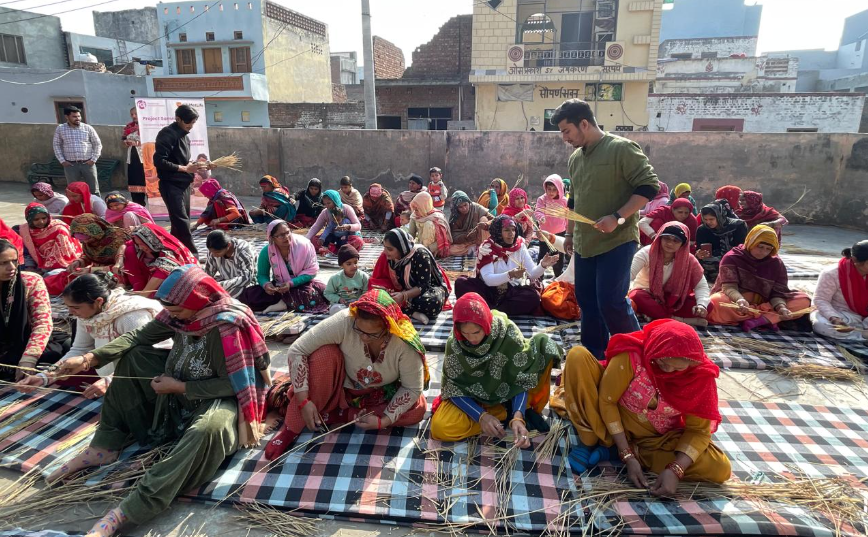
Walking into the centre, what immediately stands out is the rhythm of making. Some women carefully prepare Parali fibres, while others weave, braid, mould, or assemble products with remarkable attention to detail. Conversations flow naturally across the room, and every finished piece reflects the patience, teamwork, and dedication that have become part of the centre's identity.
As a Product Designer, I often found that the biggest design challenge wasn't the product—it was designing a process that felt familiar and comfortable for the women.
Instead of introducing unfamiliar manufacturing techniques, we worked with the knowledge they already carried. Skills like braiding, weaving, folding, and working with their hands every day became the starting point for creating new products. This approach not only made learning easier but also encouraged the women to experiment with confidence and contribute their own ideas throughout the development process.
Over time, Ram Rai became a vibrant space for both training and production. Handmade paper, decorative lamps, baskets, rope-based crafts, Parali Mache products, stationery, home décor, and lifestyle accessories gradually emerged through continuous exploration and refinement. Every product represented far more than a finished object—it reflected countless hours of collaboration, experimentation, and shared learning between designers and artisans.
Working alongside women like Renu and Monika, I witnessed how confidence grows through creation. Every new technique they learned opened the door to another possibility. Women who were initially unsure of working with a completely new material gradually began suggesting design improvements, refining production methods, and helping others master different processes. The learning environment became deeply collaborative, where knowledge was freely shared and every achievement belonged to the entire group.
One of the most rewarding aspects of working in Ram Rai has been seeing how design becomes a bridge between tradition and innovation. While the products have a contemporary appeal, the making process continues to celebrate handcrafted skills that have been part of rural life for generations. By combining these traditional abilities with sustainable materials like Parali, the centre is creating products that are not only environmentally responsible but also meaningful in today's market.
The journey has also transformed the way Parali is perceived. What was once regarded as agricultural residue is now seen as a resource capable of creating value, supporting livelihoods, and encouraging more sustainable practices. Every handcrafted lamp, sheet of handmade paper, basket, and decorative product tells a story of how thoughtful design can reshape both materials and mindsets.
Looking around the centre today, it is clear that its greatest achievement is not simply the range of products being created. It is the confidence with which women approach every new challenge, their willingness to learn, and their belief that they can create something people truly value. Those qualities cannot be measured by production numbers alone—they are reflected in every conversation, every idea shared across the worktable, and every smile that follows a finished product.
The story of Ram Rai continues to evolve with every new design, every new artisan, and every new opportunity that comes its way. It reminds us that sustainable livelihoods are built not only through skills but through trust, collaboration, and the belief that innovation belongs to everyone.
Whenever I leave the centre, I carry with me more than samples and prototypes. I leave inspired by the women whose determination has transformed Parali into products of purpose and possibility. Their journey is a reminder that meaningful design is never just about creating beautiful objects—it is about creating opportunities, strengthening communities, and proving that even the simplest materials can inspire extraordinary change
About the Author
Gaurav Khatri
Product Designer & Researcher
Foundation for Development Initiative (FDI)
Working in these villages has changed the way I look at design. I realised that the biggest challenge wasn't creating new products it was creating processes that felt natural, familiar, and empowering for the women who would make them. These stories are drawn from moments I've witnessed in the field and are dedicated to the women whose hands, ideas, and resilience continue to transform agricultural residue into products with purpose.
